Post Doctoral Associate
Center for Environmental Sciences & Engineering,
Institute of the Environment,
and
Department of Ecology & Evolutionary Biology
University of Connecticut
3107 Horsebarn Hill Road
Storrs, Connecticut 06269-4210
Phone: (860) 486-1772
FAX: (860) 486-5488
email: steven.presley@uconn.edu

 |
| King (Chinook) Salmon caught on a fly in the Salmon River, Pulaski, NY. |
Research Interests
Currently, my research has multiple foci: 1) use of a metacommunity approach to understand patterns of species distributions along latent environmental gradients, 2) evaluation of multiple dimensions of biodiversity along environmental gradients, 3) use of host-parasite systems as models to explore potential ecological and evolutionary mechanisms that mold patterns of abundance, species richness, diversity, and metacommunity structure on hosts, 4) use of plant-insect networks to evaluate partitioning of niche axes, 5) evaluation of effects of anthropogenic activities on bat populations, assemblages, and temporal activity in the Neotropics, and 6) use of data on Caribbean vertebrates to explore biogeographic factors associated with species richness, composition, or metacommunity structure.
More detailed information on:
- Dimensions of Biodiversity
- Metacommunity Structure
- Ectoparasite Populations, Communities, and Metacommunities
- Temporal Activity Patterns and Niche Partitioning
- Ecology of Natural Disturbances
- Reduced-Impact Logging in the Brazilian Amazon
- Habitat Conversion in the Peruvian Amazon
- Island Biogeography of Caribbean Bats and Birds
- Paraguayan Bats
.jpg)
Male king salmon in the Salmon River near Pulaski, NY.
Education
Bachelor of Science. 1991. Western Illinois University, Macomb, Il. Dr. Jeanette A. Thomas, Advisor.
Master of Science. 1994. Western Illinois University, Macomb, Il. Thesis Title: Small Mammals of McDonough County, Illinois. Dr. Jeanette A. Thomas, Advisor.
Doctor of Philosophy in Biology. 2004. Department of Biological Sciences, Texas Tech University, Lubbock, Texas. Dissertation Title: Ectoparasitic assemblages of Paraguayan bats: ecological and evolutionary perspectives. Dr. Michael R. Willig, Advisor. PDF
Publications
82. Willig, M.R., J. Rojas-Sandoval, and S.J. Presley. 2024. Phenological patterns in ecology: problems using circular statistics and solutions based on simulation. Methods in Ecology and Evolutionary Biology 15: 868-885. PDF
81. Van de Perre, F., M.R. Willig, S.J. Presley, H. Leirs, and E. Verheyen. 2024. The structure of Congolese shrew ensembles: competition and spatial variation in resource abundance. Journal of Mammalogy doi:10.1093/jmammal/gyae032. PDF
80. Presley, S.J., and M.R. Willig. 2023. Gradients and the structure of Neotropical metacommunities: effects of disturbance, elevation, landscape structure, and biogeography. In: Neotropical Gradients and Their Analysis (R.W. Myster, Ed.). Springer Nature, New York, New York, pages 419-450. PDF
79. Willig, M.R., and S.J. Presley. 2023. Reproductive phenologies of bat populations and ensembles from lowland Amazonia. Journal of Mammalogy 104: 752-769. PDF
78. Presley, S.J., and M.R. Willig. 2023. Long-term responses to large-scale disturbances: spatiotemporal variation in gastropod populations and communities. Oikos 2023: e09605 PDF
77. Willig, M.R., and S.J. Presley. 2023. Latitudinal gradients of biodiversity: patterns, processes, and prospects. Pages 1-20, Reference Module in Life Sciences in the Encyclopedia of Biodiversity, 3rd edition (S.M. Scheiner, editor). Elsevier Ltd., Oxford, UK. https://doi.org/10.1016/B978-0-12-822562-2.00083-9 PDF
76. Willig, M.R., S.J. Presley, B.T. Klingbeil, T. Zhang, E. Kosman, and S.M. Scheiner. 2023. Protecting biodiversity via conservation networks: taxonomic, functional, and phylogenetic considerations. Biological Conservation 278: 109876. PDF
75. Willig, M.R., and S.J. Presley. 2022. Long-term spatiotemporal variation in density of a tropical folivore: responses to a complex disturbance regime. Oecologia 199: 979-994. PDF
74. Burgio, K.R., K.E. Davis, L.M. Dreiss, L.M. Cisneros, B.T. Klingbeil, S.J. Presley, C.B. van Rees, and M.R. Willig. 2022. Integrating multiple dimensions of biodiversity to inform global parrot conservation. Animal Biodiversity and Conservation 45: 189–202. PDF
73. Presley, S.J., and M.R. Willig. 2022. From Island Biogeography to Landscape and Metacommunity Ecology: a Macroecological Perspective of Bat Communities. Annals of the New York Academy of Sciences, Special Issue: The Year in Ecology and Conservation Biology 1514: 43-61. PDF
72. Willig, M.R., and S.J. Presley. 2022. Long-term trends in gastropod abundance and biodiversity: disentangling effects of press versus pulse disturbances. Global Ecology and Biogeography 31: 247-265. PDF
71. Presley, S.J., and M.R. Willig. 2022. Long-term responses of gastropods to simulated hurricanes in a tropical montane rainforest. Ecosphere 13: e3928. PDF
70. Presley, S.J., J. Graf, A.F. Hassan, A.R. Sjodin, and M.R. Willig. 2021. Effects of host species identity and diet on the biodiversity of microbiota from Puerto Rican bats. Current Microbiology 78: 3526-3540. PDF
69. Willig, M.R., S.J. Presley, and E.I. Cullerton. 2021. A canonical metacommunity structure in a hurricane-mediated system: an environmentally consistent but spatially dynamic pattern. Oecologia 196: 919-933. PDF
68. Schowalter, T., M. Pandey, S.J. Presley, M.R. Willig, and J.K. Zimmerman. 2021. Zimmerman. Arthropods Are Not Declining But Are Responsive to Disturbance in the Luquillo Experimental Forest, Puerto Rico. Proceedings of the National Academy of Sciences 118: e2002556117. PDF
67. Presley, S.J. 2020. On the detection of metacommunity structures. Community Ecology 21:103-106. PDF
66. Van de Perre, F., M.R. Willig, S.J. Presley, I.J.-C. Mukinzi, M.S. Gambalemoke, H. Leirs, and E. Verheyen. 2020. Functional volumes, niche packing, and species richness: biogeographical legacies in the Congo Basin. Royal Society Open Science 7:191582. PDF
65. Ripple, W.J., C. Wolf, T.M. Newsome, P. Barnard, W.R. Moomaw, and 11,258 signatories from 153 countries (as one of the signatories). 2020. World scientists’ warning of a climate emergency. BioScience 70:8-12. PDF
64. Schowalter, T.D., M.R. Willig, S.J. Presley, and M. Pandey. 2019. Warnings of an “Insect Apocalypse” are premature. Frontiers in Ecology and the Environment 17:547. PDF
63. Presley, S.J., J.H.F. Mello, and M.R. Willig. 2019. Checkerboard metacommunity structure: an incoherent concept. Oecologia 190:323-331. PDF
62. Kosman, E., K.R. Burgio, S.J. Presley, M.R. Willig, and S.M. Scheiner. 2019. Conservation prioritization based on trait-based metrics illustrated with global parrot distributions. Diversity and Distributions 25:1156-1165. PDF
61. Willig, M.R., L. Woolbright, S.J. Presley, T.D. Schowalter, R.B. Waide, T. Heartsill Scalley, J.K, Zimmerman, G. González, and A.E. Lugo. 2019. Populations are not declining and food webs are not collapsing at the Luquillo Experimental Forest. Proceedings of the National Academy of Sciences 116: 12143-12144. PDF
60. Burgio, K.R., K.E. Davis, L.M. Dreiss, B.T. Klingbeil, L.M. Cisneros, S.J. Presley, and M. R. Willig. 2019. Phylogenetic supertree and functional trait database for all extant parrots. Data in Brief 24: 103882. PDF
59. Willig, M.R., and S.J. Presley. 2019. The spatial configuration of taxonomic biodiversity along a tropical elevational gradient: α-, β-, and γ-partitions. Biotropica 51: 104-116. PDF
58. Willig, M.R., S.J. Presley, J.-L. Plante, C.P. Bloch, S. Solari, V. Pacheco, and S.C. Weaver. 2019. Guild-level responses of bats to habitat conversion in a lowland Amazonian rainforest: species composition and biodiversity. Journal of Mammalogy 100: 223-238. PDF
57. Presley, S.J., L.M. Cisneros, B.T. Klingbeil, and M.R. Willig. 2019. Landscape ecology of mammals. Journal of Mammalogy 100: 1044-1068. PDF
56. Van de Perre, F., M.R. Willig, S.J. Presley, H. Beeckman, P. Boeckx, S. Cooleman, M. de Haan, A. De Kesel, S. Dessein, P. Grootaert, D. Huygens, S.B. Janssens, E. Kearsley, O. Lachenaud, M. Leponce, D. Van den Broeck, H. Verbeeck, B. Würsten, H. Leirs, and E. Verheyen. 2018. Reconciling biodiversity and carbon stock conservation in an Afrotropical forest landscape. Science Advances 4:eaar6603. doi: 10.1126/sciadv.aar6603. PDF
55. Presley, S.J., L.M. Cisneros, C.L. Higgins, B.T. Klingbeil, S.M. Scheiner, and M.R. Willig. 2018. Phylogenetic and functional underdispersion in Neotropical phyllostomid bat communities. Biotropica 50:135-145. PDF
54. Willig, M.R., and S.J. Presley. 2018. Biodiversity and disturbance. Pages 45-51 in The Encyclopedia of the Anthropocene, Vol. 3, (D.A. DellaSala and M.I. Goldstein, Eds.). Elsevier Ltd., Oxford, UK. PDF
53. Willig, M.R., and S.J. Presley. 2018. Latitudinal gradients of biodiversity: theory and empirical patterns. Pages 13-19 in The Encyclopedia of the Anthropocene, Vol. 3, (D.A. DellaSala and M.I. Goldstein, Eds.). Elsevier Ltd., Oxford, UK. PDF
52. Scheiner, S.M., E. Kosman, S.J. Presley, and M.R. Willig. 2017. The components of biodiversity, with a particular focus on phylogenetic information. Ecology and Evolution 7:6444-6454. PDF
51. Martins, A.C.M., M.R. Willig, S.J. Presley, and J. Marinho-Filho. 2017. Effects of forest height and vertical complexity on abundance and biodiversity of bats in Amazonia. Forest Ecology and Management 391:427-435. PDF
50. Schowalter, T., M.R Willig, and S.J. Presley. 2017. Post-hurricane successional dynamics in abundance and diversity of canopy arthropods in a tropical rainforest. Environmental Entomology 46:11-20. PDF
49. Hudson, L. N. et al. (510 collaborators). 2017. The database of the PREDICTS (Projecting Responses of Ecological Diversity in Changing Terrestrial Systems) Project. Ecology and Evolution 7:145-188. PDF
48. Willig, M.R., and S.J. Presley. 2017. Latitudinal gradients of biodiversity. Pages 1-17 in Reference Module in Life Sciences. Elsevier Ltd., Oxford, UK. PDF
47. Scheiner, S.M., E. Kosman, S.J. Presley, and M.R. Willig. 2017. Decomposing functional diversity. Methods in Ecology and Evolution 8:809-820. PDF
46. Willig, M.R., and S.J. Presley. 2016. Biodiversity and metacommunity structure of animals along altitudinal gradients in tropical montane forests. Journal of Tropical Ecology 32:421-436. PDF
45. Presley, S.J., T. Dallas, B.T. Klingbeil, and M.R. Willig. 2015. Phylogenetic signals in host-parasite associations for Neotropical bats and Nearctic desert rodents. Biological Journal of the Linnean Society 116: 312-347. PDF
44. Dreiss, L.M., K.R. Burgio, L.M. Cisneros, B.T. Klingbeil, B.D. Patterson, S.J. Presley, and M.R. Willig. 2015. Taxonomic, functional, and phylogenetic dimensions of rodent biodiversity along an extensive tropical elevational gradient. Ecography 38: 876-888. PDF
43. López-González, C., S.J. Presley, A. Lozano, R.D. Stevens, and C.L. Higgins. 2015. Ecological biogeography of Mexican bats: the relative contributions of habitat heterogeneity, beta diversity, and environmental gradients to species richness and composition patterns . Ecography 38: 261-272. PDF
42. Hudson, L., et al. (243 collaborators). 2014. The PREDICTS database: a global database of how local terrestrial biodiversity responds to human impacts. Ecology and Evolution 24: 4701-4735. PDF
41. Carvalho, D.M., S.J. Presley, and G.M.M. Santos. 2014. Niche overlap and network specialization of flower-visiting bees in an agricultural system. Neotropical Entomology 43: 489-499. PDF
40. Santos, G.M.M., W. Dáttilo, and S.J. Presley. 2014. The seasonal dynamic of ant-flower networks in a semi-arid tropical environment. Ecological Entomology 39: 674-683. PDF
39. Presley, S.J., S.M. Scheiner, and M.R. Willig. 2014. Evaluation of an integrated framework for biodiversity with a new metric for functional dispersion. PLoS ONE 9(8): e105818. doi:10.1371/journal.pone.0105818. PDF
38. de la Sancha, N., C.L. Higgins, S.J. Presley, and R.E. Strauss. 2014. Metacommunity structure in a highly fragmented forest: has deforestation in the Atlantic Forest altered historic biogeographic patterns? Diversity and Distributions 20: 1058-1070. PDF
37. Cisneros, L.M., K.R. Burgio, L.M. Dreiss, B.T. Klingbeil, B.D. Patterson, S.J. Presley, and M.R. Willig. 2014. Multiple dimensions of bat biodiversity along an extensive tropical elevational gradient. Journal of Animal Ecology 83: 1124-1136. PDF
36. Dallas, T., and S.J. Presley. 2014. Relative importance of host environment, transmission potential, and host phylogeny to the structure of parasite metacommunities. Oikos 123: 866-874. PDF
35. Willig, M.R., C.P. Bloch, and S.J. Presley. 2014. Experimental decoupling of canopy opening and debris deposition on tropical gastropod populations and communities. Forest Ecology and Management 332: 103-117.PDF
34. Schowalter, T.D., M.R Willig, and S.J. Presley. 2014. Canopy Arthropod Responses to experimental canopy opening and debris deposition in a tropical rainforest subject to hurricanes. Forest Ecology and Management 332: 93-102.PDF
33. Willig, M.R., S.J. Presley, C.P. Bloch, and J. Alvarez. 2013. Population, community, and metacommunity dynamics of terrestrial gastropods in the Luquillo Mountains: a gradient perspective. In: Ecological Gradient Analyses in a Tropical Landscape, G. González, M.R. Willig, and R. B. Waide, editors. Ecological Bulletins 54:117-140. PDF
32. Willig, M.R., and S.J. Presley. 2013. Latitudinal gradients of biodiversity. Pages 612-626 in Encyclopedia of Biodiversity, 2nd edition, Volume 4 (S. Levin, Ed.). Academic Press, Waltham, Massachusetts. Email author for PDF.
31. Aguiar, C.M.L., G.M.M.Santos, C.F. Martins, and S.J. Presley. 2013. Trophic niche breadth and niche overlap in a guild of flower-visiting bees in a Brazilian dry forest. Apidologie 44:153-162. PDF
30. Presley, S.J., L.M. Cisneros, B.D. Patterson, and M.R. Willig. 2012. Vertebrate metacommunity structure along an extensive elevational gradient in the tropics: a comparison of bats, rodents and birds. Global Ecology and Biogeography 21:968-976. PDF
29. Brito, A.F., S.J. Presley, and G.M.M. Santos. 2012. Temporal and trophic niche overlap in a guild of flower-visiting ants in a seasonal semi-arid tropical environment. Journal of Arid Environments 87:161-167. PDF
28. Presley, S.J. 2012. Sex-based population structure of ectoparasites from Neotropical bats. Biological Journal of the Linnean Society 107:56-66. PDF
27. López-González, C., S.J. Presley, A. Lozano, R.D. Stevens, and C.L. Higgins. 2012. Metacommunity analysis of Mexican bats: environmentally mediated structure in an area of high geographic and environmental complexity. Journal of Biogeography 39:177-192. PDF
26. Willig, M.R., S.J. Presley, C.P. Bloch, I. Castro-Arellano, L.M. Cisneros, C.L. Higgins, and B.T. Klingbeil. 2011. Tropical metacommunities along elevational gradients: effects of forest type and other environmental factors. Oikos 120:1497-1508. PDF
25. Presley, S.J. 2011. Interspecific aggregation of ectoparasites on bats: importance of hosts as habitats supersedes interspecific interactions. Oikos 120: 832-841. PDF
24. Presley, S.J., M.R. Willig, C.P. Bloch, I. Castro-Arellano, C.L. Higgins, and B.T. Klingbeil. 2011. A complex metacommunity structure for gastropods along an elevational gradient. Biotropica 43: 480-488. PDF
23. Willig, M.R., S.J. Presley, and C.P. Bloch. 2011. Long-term dynamics of tropical walking sticks in response to multiple large-scale and intense disturbances. Oecologia 165:357-368. PDF
22. Santos, G.M.M., and S.J. Presley. 2010. Niche overlap and temporal activity patterns of social wasps in a Brazilian cashew orchard. Sociobiology 56:121-131. PDF
21. Presley, S.J., C.L. Higgins, and M.R. Willig. 2010. A comprehensive framework for the evaluation of metacommunity structure. Oikos 119:908-917. PDF
20. Presley, S.J., and M.R. Willig. 2010. Bat metacommunity structure on Caribbean islands and the role of endemics. Global Ecology and Biogeography 19:185-199. PDF
19. Willig, M.R., S.J. Presley, C.P. Bloch, and H.H. Genoways. 2009. Macroecology of Caribbean bats: effects of area, elevation, latitude, and hurricane-induced disturbance. Pages 216-264 in Island bats: evolution, ecology, and conservation (T. Fleming, and P. Racey, Eds.). University of Chicago Press. PDF
18. Castro-Arellano I., S.J. Presley, M.R. Willig, J.M. Wunderle, and L.N. Saldanha. 2009. Reduced-impact logging and temporal activity of understorey bats in lowland Amazonia. Biological Conservation 142:2131-2139. PDF
17. Presley, S.J., C.L. Higgins, C. López-González, and R.D. Stevens. 2009. Elements of metacommunity structure of Paraguayan bats: multiple gradients require analysis of multiple axes of variation. Oecologia 160:781-793. PDF
16. Presley, S.J., M.R. Willig, L.N. Saldanha, J.M. Wunderle, and I. Castro-Arellano. 2009. Reduced-impact logging has little effect on temporal activity of frugivorous bats (Chiroptera) in lowland Amazonia. Biotropica 41:369-378. PDF
15. Presley, S.J., M.R. Willig, I. Castro-Arellano, and S.C. Weaver. 2009. Effects of habitat conversion on activity patterns of phyllostomid bats in lowland Amazonian rainforest. Journal of Mammalogy 90:210-221. PDF
14. Presley, S.J., and M.R. Willig. 2008. Composition and structure of Caribbean bat (Chiroptera) assemblages: effects of inter-island distance, area, elevation, and hurricane-induced disturbance. Global Ecology and Biogeography 17:747-757. PDF
13. Presley, S.J., and M.R. Willig. 2008. Intraspecific patterns of ectoparasite abundances on Paraguayan bats: effects of host sex and body size. Journal of Tropical Ecology 24:75-83. PDF
12. Presley, S.J., M.R. Willig, J.M. Wunderle, and L.N. Saldanha. 2008. Effects of reduced-impact logging and forest physiognomy on bat populations of lowland Amazonian forest. Journal of Applied Ecology 45:14-25. PDF
11. Stevens, R.D., C. López-González, and S.J. Presley. 2007. Geographical ecology of Paraguayan bats: spatial integration and metacommunity structure of interacting assemblages. Journal of Animal Ecology 76:1086-1093. PDF
10. Presley, S.J. 2007. Streblid bat-fly assemblage structure on Noctilio leporinus (Chiroptera: Noctilionidae): nestedness and species co-occurrence. Journal of Tropical Ecology 23:409-417. PDF
9. Castro-Arellano, I., S.J. Presley, L.N. Saldanha, M.R. Willig, and J.M. Wunderle. 2007. Effects of low-intensity logging on bat biodiversity in terra firme forest of lowland Amazonia. Biological Conservation 138:269-285. PDF
8. Willig, M.R., S.J. Presley, C.P. Bloch, C.L. Hice, S.P. Yanoviak, M.M. Díaz, L. Arias Chauca, V. Pacheco, and S.C. Weaver. 2007. Phyllostomid bats of lowland Amazonian: effects of habitat alteration on abundance. Biotropica 39:737-746. PDF
7. Presley, S.J. 2005. Ectoparasitic assemblages of Paraguayan bats: ecological and evolutionary perspectives. Mastozoología Neotropical 12:103-105. PDF
6. López-González, C., and S.J. Presley. 2001. Taxonomic status of Molossus bondae J. A. Allen (Chiroptera: Molossidae), 1904, with new records for Argentina, Brazil, and Paraguay and description of a new subspecies. Journal of Mammalogy 82:760-774. PDF
5. López-González, C., S. J. Presley, R. D. Owen, and M. R. Willig. 2001. The taxonomic status of Myotis (Chiroptera: Vespertilionidae) in Paraguay. Journal of Mammalogy 82:138-160. PDF
4. Willig, M.R., S.J. Presley, R.D. Owen, and C. López-González. 2000. Composition and structure of bat assemblages in Paraguay: a subtropical – temperate interface. Journal of Mammalogy 81:386-401. PDF
3. Presley, S.J. 2000. Eira barbara. Mammalian Species 636:1-6. PDF2. Presley, S.J. 2000. (Review of) Ecología de los Vertebrados de Chile by A.F. Jaksic. Journal of Mammalogy 81:282-284.
1. López-González, C., S.J. Presley, R.D. Owen, M.R. Willig, and I. Gamarra de Fox. 1998. Noteworthy records of bats (Chiroptera) from Paraguay. Mastozoología Neotropical 5:41-45.PDF
Data Papers
4. Presley, S.J., and M.R. Willig. 2023. Long-term responses to large-scale disturbances: spatiotemporal variation in gastropod populations and communities. Dryad, Dataset, https://doi.org/10.5061/dryad.44j0z.
3. Willig, M.R., and S.J. Presley. 2022. Long-term trends in gastropod abundance and biodiversity: disentangling effects of press versus pulse disturbances, Dryad, Dataset, https://doi.org/10.5061/dryad.1zcrjdft4.
2. Presley, S.J., T. Dallas, B.T. Klingbeil, and M.R. Willig. 2015. Data from: Phylogenetic signals in host-parasite associations for Neotropical bats and Nearctic desert rodents, Dryad, Dataset, https://doi.org/10.5061/dryad.bp62d PDF
1. Presley, S.J. 2012. Data from: Sex-based population structure of ectoparasites from Neotropical bats, Dryad, Dataset, https://doi.org/10.5061/dryad.ch2pq65h. PDF
Submitted Manuscripts
Presley, S.J., J. Rojas-Sandoval, and M.R. Willig. Long-term stability of plant metacommunities in tropical forests of Puerto Rico: considerations of native and non-native species. Biotropica (Submitted).
Dornelas, et al. (100s of authors, including S.J. Presley). 2024. BioTIME 2.0: expanding and improving a database of biodiversity time series. Global Ecology and Biogeography (Submitted).
Willig, M.R., and S.J. Presley. 2024. Latitudinal gradients of biodiversity: theory and empirical patterns. In: The Encyclopedia of the Anthropocene, Vol. 3, Second edition (D.A. DellaSala and M.I. Goldstein, Eds.). Elsevier Ltd., Oxford, UK, Pages xx-xx.
Willig, M.R., and S.J. Presley. 2024. Biodiversity and disturbance. In: The Encyclopedia of the Anthropocene, Vol. 3, Second Edition (D.A. DellaSala and M.I. Goldstein, Eds.). Elsevier Ltd., Oxford, UK, Pages xx-xx.
Scheiner, S.M., E. Kosman, S.J. Presley, and M.R. Willig. 2024. The units of biodiversity. Ecological Monographs (Submitted).
Burgio, K.R., L.M. Cisneros, K.E. Davis, L.M. Dreiss, B.T. Klingbeil, B.D. Patterson, S.J. Presley, and M.R. Willig. Dimensions of passerine biodiversity along an elevational gradient: a nexus for historical biogeography and contemporary ecology. Ornithology (Submitted).
Schowalter, T.D., S.J. Presley, and M.R. Willig. 2024. Variation in biodiversity and abundance of functional groups of arthropods along a tropical elevational gradient in Puerto Rico. Biotropica (Submitted).
Waide, R.B., B.S. Barker, S.J. Presley, J.J. Thompson, J. Torres-Díaz, and M.R. Willig. 2024. Repeated disturbances restructure a tropical bird community. Ecology Letters. (Submitted).
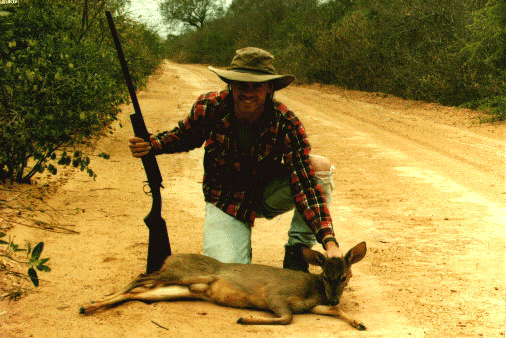 |
Adult male gray brocket (Mazama gouazoubira) killed near Destacamento Militar Gabino Mendoza, in the Gran Chaco of Paraguay
|