Cory Merow
Smithsonian Environmental Research Center
Quantitative Ecology Group
and
University of Connecticut
Department of Ecology and Evolutionary Biology
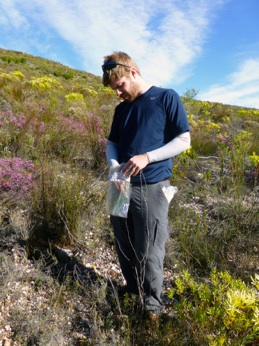
I am an ecologist interested in modeling strategies for community and population level processes. I’m interested in how we draw conclusions from data, and how confident we are in those conclusions. I try to balance mathematical or statistically rigorous analyses with biological and ecological sensibilities to produce models that accurately reflect our assumptions and data, while highlighting which parts of our inference derive from each. Thus far, I’ve focused on maximum entropy methods, Bayesian methods, and simulations with cellular automata. I conduct my field research in the fynbos vegetation of South Africa, where I focus on explaining abundance patterns along ecological gradients based on traits. I am fortunate to work with John Silander at the University of Connecticut, where we focus on quantitative methods for understanding spatial patterns in ecology. As of November 2012, I’m moving temporarily to Microsoft Research, Ltd. in Cambridge, UK to work with Matthew Smith before beginning a post-doc position with Sean McMahon at the Smithsonian Environmental Research Center in February 2013.
Current Projects
A practical guide to Maxent: What it does, and why inputs and settings matter
with Matthew Smith and John Silander
We’re developing a suite of methods to better explore distribution models built with Maxent. In my opinion, many models built with default settings in Maxent are overly complex and therefore compromise their transferability and interpretation. I’m outlining a modeling strategy to produce simpler models based on a set of new techniques for significance testing of predictors and model comparison diagnostics. These methods will help users explore the consequences of Maxent’s assumptions and better understand their models to produce more robust predictions. Methods will be implemented in R, to use with any data set.
Advancing demography in ecology with integral projection models: a practical guide
with Johan P. Dahlgren, C.J.E. Metcalf, Dylan Childs, M.E.K. Evans, Eelke Jongejans, Sydne Record, Mark Rees, Roberto Salguero-Gómez, Sean McMahon
Integral Projection Models (IPMs) link demography to the ecological processes that shape populations. Here, we review important resources for building IPMs and describe in detail how to build IPMs for a variety of life histories of increasing complexity and biological realism. Throughout, we emphasize how IPMs can offer mechanistic insights into population-level patterns. IPMs have the flexibility to represent life histories at any desired level of biological detail. These life histories are characterized by using observations of individuals to determine generalities in vital rates among individuals, and used to predict population dynamics and emergent biological patterns.
Protea demography using Bayesian integral projection models
with John Silander, Adam Wilson and Andrew Latimer
To understand a species’ response to a changing environment, it is critical to relate demographic heterogeneity back to its environmental drivers. Typically climate variables that represent average weather over a 30 or 50-year interval are used to characterize the environment, however these are only proxies for more physiologically relevant predictors (e.g. maximum drought length). We’re developing a daily weather data set from which to construct these predictors that includes uncertainty. I’m developing demographic models that relate vital rates back to these environmental drivers. This will allow us to map predicted population viability, including uncertainty, based on environmental conditions across the species’ range.
Experimental demography of two invasive plants and their native analogs along environmental gradients using integral projection models
with Sarah T. Bois and John Silander
Invasive species’ geographic distributions are often not at equilibrium in their invasive ranges. Therefore, inferring population dynamics based on current locations of populations may under- or over-estimate population growth rates and potential spread. We took an experimental approach to investigating the underlying demographic processes that drive population dynamics across a range of environmental conditions that are hypothesized to be invasible. The link between environment and demography is particularly important for understanding invasive species distributions to improve early detection abilities and to design appropriate management actions.
Bayesian integral projection models for testing demographic hypotheses
with John Silander and Mark Brand
Integral projection models represent the next generation of demographic models. They offer all of the advantages of matrix models in addition to many new features. I’m outlining a Bayesian framework to test demographic hypotheses, given incomplete vital rate data, that rigorously accounts for uncertainty in model parameters. The outcome (hopefully) will be a set of R tools to build IPMs for an arbitrary data set to rigorously capture the demographic information (e.g. population growth rates, stable stage distributions, etc.) contained in incomplete data while properly accounting for uncertainty in the estimates. As a case study, I’m applying this protocol to evaluate the invasive threat of 17 cultivars of Japanese barberry (Berberis thunbergii) in the northeastern United States.
Community abundance patterns in South African fynbos
with John Silander, Adam Wilson, Jasper Slingsby, Andrew Latimer, Kent Holsinger, Cynthia Jones and Carl Schlichting
This work is part of a larger collaborative effort focused on understanding the different aspects of biodiversity in plant communities in the Greater Cape Floristic Region (GCFR) of South Africa. The larger project seeks to understand the relationship between functional traits and patterns of genetic, functional and taxonomic diversity. Our goal is to integrate knowledge collected at these different scales to predict species and community responses, enhanced by understanding their evolutionary past. I’m focusing on determining how community-level distributions of functional traits vary along ecological gradients and how this variation can predict species’ abundance patterns. Here’s a brief article about the project: link.
NOTE: substantial edits in progress after a year or so of neglect.... (Feb. 10, 2013)